
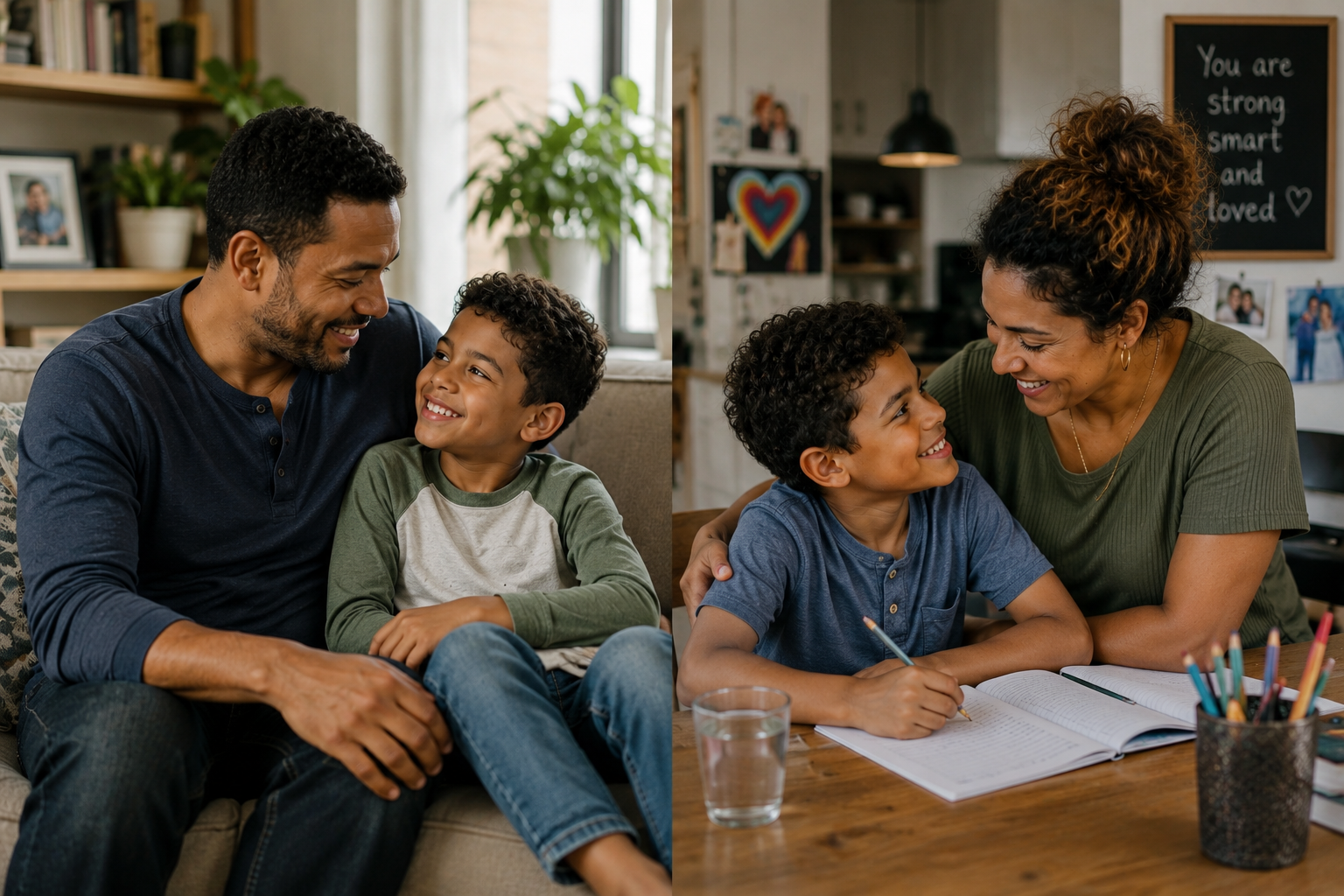
A straight-talking guide for divorced parents – the things that help, and the things that hurt.
What You Say and Don’t Say as Divorced Parents
- ✅ Do tell your children, clearly and repeatedly, that the divorce was not their fault.
- ✅ Do reassure them that both parents still love them and that this will never change.
- ✅ Do give them honest, age-appropriate explanations of what is happening.
- ✅ Do let them ask questions, and answer as truthfully as you can without oversharing.
- ❌ Don’t badmouth your ex in front of your children…not directly, not sarcastically, not “just venting.”
- ❌ Don’t make negative comments about your ex’s new partner, family, or lifestyle within earshot.
- ❌ Don’t say things like “you’re just like your father/mother” as a criticism.
- ❌ Don’t share adult details about the reasons for the divorce (like finances, infidelity, or legal disputes) with your children.
- ❌ Don’t tell them more than they need to know just because you need to tell someone. As divorced parents, the kids come first.
Don’t Use Your Kids
- ❌ Don’t use your children as messengers between you and your ex.
- ❌ Don’t pump them for information about what is happening in your ex’s house or life.
- ❌ Don’t ask them to keep secrets from the other parent.
- ❌ Don’t use them as leverage in financial or legal disputes.
- ❌ Don’t make them feel like they have to choose sides.
- ❌ Don’t put them in a position where showing love for the other parent feels like they’re betraying you.
- ❌ Don’t use their events (birthdays, school plays, sports days) as battlegrounds for adult conflict.
Your Own Behaviour
- ✅ Do take care of your own mental health so your distress doesn’t fall on your children. This could be in the form of therapy, support groups, or trusted friends. Divorced parents need help, and that’s ok.
- ✅ Do model how to handle difficult situations with some degree of grace, even when it is hard.
- ✅ Do acknowledge to your children that this is hard for you too, without making them responsible for managing your emotions.
- ✅ Do give yourself permission to have bad days, while keeping those days away from your children as much as possible.
- ❌ Don’t cry to your children about the divorce or treat them as emotional support.
- ❌ Don’t make your child feel responsible for your happiness.
- ❌ Don’t speak about your ex with barely concealed contempt and expect your children not to notice.
Co-Parenting
- ✅ Do communicate directly with your ex about the children in a calm, factual way, with the kids’ interests as the core principle.
- ✅ Do try to align on basic rules regarding bed times, nutrition, school work, and so on across both households, even if you agree on little else.
- ✅ Do keep your ex informed about significant events in your children’s lives, including medical issues, school concerns, friendship problems, and so on.
- ✅ Do make it easy for your children to contact the other parent whenever they want to.
- ✅ Do present a united front on major decisions, even if you had to argue your way to it privately.
- ❌ Don’t have hostile exchanges with your ex in front of your children.
- ❌ Don’t cancel or repeatedly reschedule your time with the children without good reason.
- ❌ Don’t compete with your ex for your children’s affection by showering them with gifts, being excessively permissive, or always being the “fun” parent.
- ❌ Don’t undermine the rules your ex has set just because you can.
Guilt Parenting
- ❌ Don’t compensate for guilt by abandoning all boundaries. Children need structure more.
- ❌ Don’t say yes to everything because you feel bad about the situation.
- ❌ Don’t buy their happiness. It doesn’t work and they know what you’re doing.
- ✅ Do understand that guilt is normal, and that the antidote is being there for them consistently.
- ✅ Do recognise that a boring, predictable, stable weeknight at home is worth more to them than a guilt-fuelled weekend away.
Their Feelings
- ✅ Do let your children feel whatever they feel without trying to fix or redirect it.
- ✅ Do validate their experience even when it is uncomfortable by saying something like, “I know this is really hard, and it makes sense that you feel that way.”
- ✅ Do watch for signs of prolonged struggle and act on them. These signs may include withdrawal, declining performance at school, changes in sleep or appetite, or expressions of hopelessness.
- ✅ Do consider professional support if they are not getting through the adjustment phase.
- ❌ Don’t tell them they should be over it by now.
- ❌ Don’t dismiss their sadness because you believe the divorce was ultimately the right decision.
- ❌ Don’t expect them to feel better just because you do.
Practicalities
- ✅ Do make sure they know the schedule clearly and have a consistent routine in both homes.
- ✅ Do ensure both homes feel like their space. Divorced parents need to make sure they’re BOTH the safe space.
- ✅ Do keep their schools, doctors, and key contacts informed of the change in family structure where relevant.
- ✅ Do make sure they can move between households without feeling like they are carrying messages, tension, or loyalty demands in their bags.
Remember: None of this is easy and, as divorced parents, we won’t get it right every time. The goal is to keeping moving a consistent direction.

Leave a Reply