
Connecting to your children after a divorce doesn’t need grand gestures, expensive gifts, constant entertainment, or carefully orchestrated heart-to-heart conversations. In fact, those approaches often backfire. Children, especially those processing something as major as a family split, tend to open up sideways. They talk when they’re doing something else, when nobody is watching them too closely, and when they feel no pressure to perform emotions on cue.
The ideas below are easy, free, and low-pressure. Some will suit your child; some won’t. Try a few and let them lead. And if they don’t feel like they’re working, move on, try something else, and come back to them. There’s no rush or timeline.
Let Boredom Do the Work
This one sounds like doing nothing, mostly because it is. A Saturday afternoon with no plan, screens, or agenda is more likely to produce an unexpected conversation than a scheduled “let’s talk about our feelings” session, which children can smell coming from a mile away and will do almost anything to avoid.
Sit near them. Putter around the house. Let silence exist without filling it. Children who feel watched and questioned tend to go very quiet, while children who simply feel the closeness of your company tend, eventually, to start talking. Patience is the only skill required here, which is either reassuring or annoying depending on your personality type.
Cook Something Together
Cooking gives everyone a specific task to focus on, which takes the pressure off the conversation. Chopping, stirring, and trying to remember whether you put in a teaspoon or a tablespoon of salt create a natural side-by-side dynamic that children find far less confronting than sitting face to face and being asked how they are doing.
Let them choose what to make; even if it involves an alarming quantity of cheese, follow their lead. The point is not the food. It’s the 45 minutes of standing next to each other, talking about nothing in particular, which turns out to be everything.
Start a Running Project
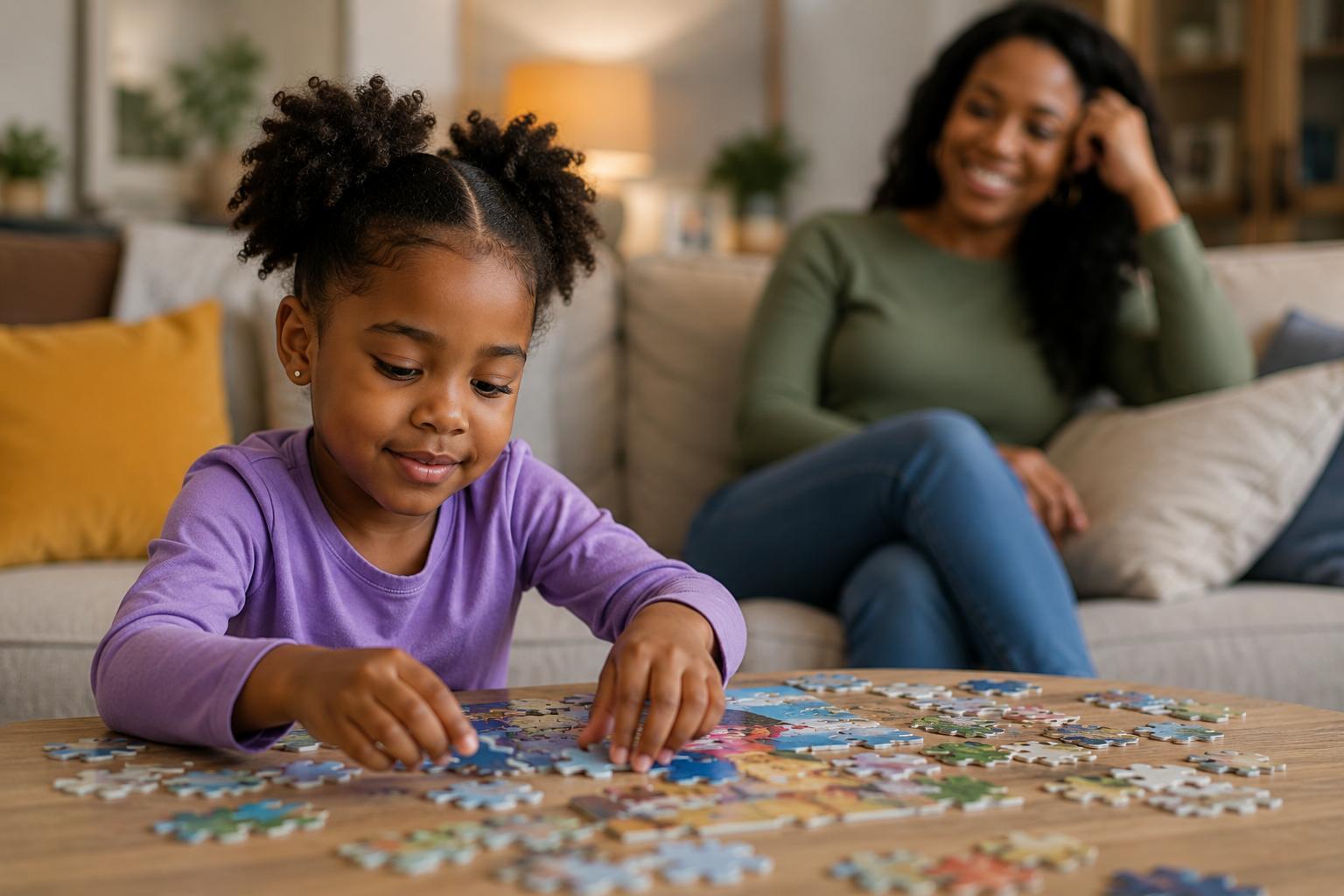
Start a project with no deadline and no real stakes; like a puzzle left out on a table, a garden bed that needs watering and weeding, a birdwatching list, a recipe collection, a scrapbook. These projects give you both something to do over time. It creates continuity and a small shared world that exists just between the two of you.
It doesn’t need to be impressive. A half-finished 500-piece puzzle of a lighthouse that has been sitting on the dining room table for three weeks is doing more work than it looks like it is doing.
Read the Same Book to Connect
Pick something you can both read and talk about. This doesn’t have to be in a formal book club way, but in a casual, low-key way. A funny chapter book for younger children, a graphic novel, a series they are already devoted to…Read ahead so you can talk about the characters and what might happen next. This is a connection.
Stories give children a safe distance from which to explore big emotions. A character’s fear, anger, or sadness can say things that a child is not yet ready to say in their own voice. Fiction is useful like that.
Go Somewhere That Isn’t About Talking
Go to a movie, a live sports match, a market, a nature walk, or head out on a drive with the music on. Activities that face outward rather than inward remove the expectation of emotional labour from both of you. The shared experience becomes the connection, without anyone having to say it out loud.
Afterwards, keep it casual. “What was your favourite part?” is enough of an opener. You do not need to engineer a deeper conversation. If one is coming, it’ll arrive on its own schedule, probably on the drive home when you’re nearly back and there is no time to get into it properly. That is just how children work.
Create a Low-Stakes Ritual
It just needs to be consistent, not meaningful. It can be Friday night pizza, a particular playlist in the car, hot chocolate after school on Wednesdays, breakfast for dinner once a week (I’ll never understand why children find this so thrilling…it’s just eggs at the wrong time of day. But, it works!)
Rituals tell children that some things are predictable and reliably theirs, which is exactly what they need more of right now. Over time, these small routines become anchors and often the place where the most unexpected conversations and connections surface.
Give Them a Creative Outlet and Step Back
Art supplies, a cheap journal, an old phone or camera to take photos with, musical instruments available without the immediate threat of being asked to practise scales…Creative expression lets children process things they cannot yet put into words.
Your job is not to interpret or analyse what they produce, or to suggest any improvements. It’s simply to make the art and craft supplies available and show genuine interest without turning it into a debrief.
Play Their Games, Not Yours
If your child is into a video game, a card game, a particular sport, or even something you find boring or mildly bewildering, ask them to teach you. Children light up when they are the expert and the adult is the confused one fumbling around and getting things wrong. It shifts the dynamic in a way that is genuinely good for their confidence, and it shows them that their world is worth your time and attention.
You don’t have to pretend to love it. Being honestly terrible at something and laughing about it together is connection enough. Possibly better, in fact.
Write Notes
For children who find verbal communication harder (and many do, particularly at certain ages and stages), written communication can be a revelation. A small notebook passed back and forth, notes in a lunchbox, or a whiteboard in the kitchen where you leave each other messages may start as practical information, but often become something more.
Some children will write things in a note that they would never say out loud. If this opens up, keep the written conversation going without making a big deal of it. Treat it as normal, because it is.
Be Physically Present Without Demanding Emotional Presence
Sit in the same room while they do their thing. Watch them practise something or be nearby while they play. Physical proximity without expectation is its own form of reassurance. It says, “I’m here” without needing anything in return (including conversation, eye contact, or acknowledgment of your existence).
This can feel thankless, but it’s not. Children who feel their parent is simply, reliably present develop a sense of security that makes it considerably easier to talk when they are ready. You are not wasting time by just being in the room. You are doing something that matters, even if it currently looks a lot like sitting on the sofa while someone ignores you.
A Note on Timing
Children rarely open up and connect at the moment you have set aside for it. They open up in the car, at bedtime, in the middle of making dinner and carrying the hottest roasting tray, or right after you’ve sat down to watch something you’ve been looking forward to all week. When it happens, stop what you are doing if you possibly can, and listen without redirecting, fixing, or rushing to reassure. Sometimes the most valuable thing you can do is say very little and let them keep going.
Connection after divorce is not built in a single conversation. It is built in small, repeated moments that add up to a child who knows, without needing to be told, that they are not alone.
Leave a Reply